
Author: Universe Earth Library
Lately, I have been seeing a familiar yet absurd scene in spiritual circles:
the number of people “anti Cobra” suddenly rises, the volume grows louder, emotions get heavier, and the reasoning gets thinner. Some opposition looks like it is discussing the content, but is actually switching concepts midstream. It looks like it is analyzing information, but is really wrapping emotion into a conclusion. It wears the costume of critique, yet more often it is simply self protection, a way to say, “My anxiety needs someone to carry the blame.”
I want to write this clearly, not to defend anyone, and not to start a fight. What I want is to lay out the common psychological path and the typical cracks in the arguments, so more people can see how idol worship quietly pushes someone toward extremes, until they end up tearing what they once believed most into the target they hate the most.
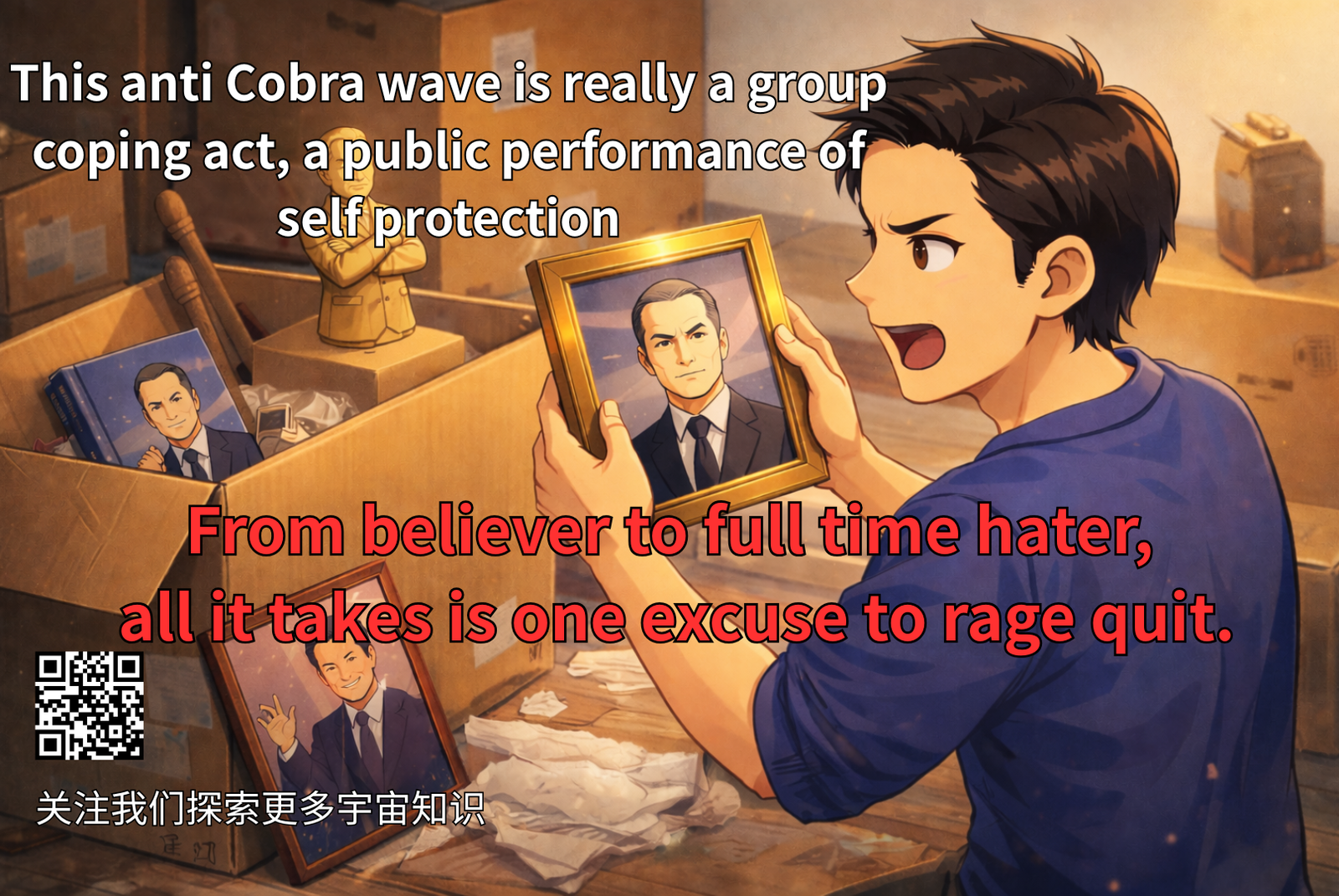
1.Illogical Opposition: Why It Feels “Abnormal” to Me
I have always felt that opposing a person or an idea without logic or any real reason is one of the strangest things. Opposition can have a stance, but it still needs reasons. Disagreement is fine, but it should be able to point to what does not hold up. What I often see instead is this: a verdict first, and then feelings used as “evidence.”
To me, this kind of logic free opposition looks more like an abnormal pattern, not an intelligence problem, but psychological defenses spinning out of control. When someone cannot digest inner anxiety, shame, loss, or frustration, the easiest move is to outsource it. Package it like a stone and throw it at a name the crowd can recognize.
And most of the time, there is the same fuse behind it: an extreme reaction after a collapse of faith.
2.The Core of a Faith Collapse: Not “Disappointment,” but a Personal Narrative Cave In
The scariest part of a faith collapse is not “I no longer believe.” It is “I do not know what I have been doing all these years.” When someone stakes their hope, meaning, even their life direction on a certain story, and that story does not unfold as expected, the pain is not only unmet expectations. It is their self worth being forced to face a vacuum.
At that point, the mind triggers a survival impulse: I cannot admit that I misread it, that I projected, that I became dependent, because it hurts too much. So the easier version appears: it is all the other person’s fault. They lied. They made me wait.
That is why I am writing this. I do not want that pain to explode outward in an uglier, more extreme form.
3.A Simple Contrast That Reveals Scarcity Mindset
I often use a simple example to test this psychological state.
If I have a house, a car, and hundreds of millions in savings, and I know about “the Event,” then even if ten years pass and it still has not happened, would I become so upset, so uneasy, so anxious that I lose control?
In most cases, I would not. I might still hope, observe, and adjust my understanding, but I would not push myself into living every day like I am hanging in midair. So why do some people react that way?
The more I watch, the more I feel the true root is often not “the Event,” but scarcity mindset. A deep sense of insecurity. It is not that I lack information, I lack control. It is not that I lack answers, I lack the stability to keep living my life. So the Event becomes a lifeline. And once that lifeline does not pull me ashore on schedule, I start imagining it as a noose tightening around my neck.
That is why I say the core source behind these behaviors is not only the collapse of idol worship, but also a deep scarcity mindset underneath.
4. The “Obsessive Ex” Effect: The Deeper the Investment, the More Destructive It Can Become
This is the metaphor that feels most accurate to me: the “obsessive ex” effect.
When someone pours time, energy, even money into pursuing a person, chasing for a long time and expecting for a long time, and still cannot get what they want, some people do not step back. They go extreme. They start wanting to destroy the other person. Not because the other person truly did something unforgivable, but because the sentence “I invested so much” becomes the heaviest lever in their mind.
In the same way, going from believer to hater is often not a slow cooling. It is a sudden explosion. And the function of that explosion is not truth seeking. It is to cover the hardest sentence to say out loud: I cannot bear that I once believed that much.
5.A Grounded Reality Check: Profit Is Not Illegality, and Storytelling Is Not Product Placement
Beyond psychology, I also need to make the real world side clear. Because one of the most common accusations from critics goes like this: the moment Cobra mentions minerals or meteorites, they jump straight to “He has been blogging for over a decade just to sell rocks.”
I have to say this plainly. Earning money is not illegal in itself. Yes, Cobra has mentioned burying minerals and meteorites over the years, but he did not, or at least not every time, attach purchase links directly to his updates or tell people they must buy anything. Under that condition, it is hard to even label it as product placement, let alone stretch it into “He spent thirteen years setting this up to sell stones.” That conclusion lacks a valid cause and effect chain. The logic does not hold.
And if we step back and look at everyday life, storytelling and value sharing that naturally lead into products, resources, or calls to action are everywhere. Books, courses, videos, columns, brand philosophies, even charity fundraising often use narrative to carry values and motivate action. Narrative and commerce can exist at the same time. “The content has value” and “someone benefits financially from it” are not mutually exclusive. What we should actually be wary of is deception, coercion, and fear based extortion, not treating all commerce as original sin.
Reality is simple. People have living needs, and anyone trying to push projects forward also needs resources. Earning income through legal and reasonable means is not morally or legally wrong. I am not writing this to ask anyone to believe blindly. I am writing it to ask people to finish the reasoning before they deliver a verdict, and not replace evidence with emotional leaps.
6.The Event Fantasy and Subjective Reading: When Prediction Gets Misheard as a Promise, Waiting Becomes “Betrayal”
I have also seen another type of critic whose starting point is not malice, but longing. They desperately want “the Event” or “the Great Shift” to arrive by a certain time, so they over interpret Cobra’s messages and assume he guaranteed that it would happen within a specific window.


But the core concept needs to be nailed down. There was no such blank check. Even if Cobra made something that sounds like a forecast, a forecast is still a forecast. Turning a prediction into a promise is a script the listener adds in their own mind, not a contract the speaker signed.
At the same time, I have always been clear about how I see Cobra’s role. He is closer to a news anchor, receiving limited intelligence and then organizing and relaying it. He is not an all knowing being speaking from a divine, godlike vantage point. And if someone is not all knowing, then error, revision, or gaps in interpretation are inevitable. That is the reality of information transfer, not proof for a moral trial.
The real problem lies in the structure of idol worship. People caught in idol worship often cannot accept even a small mistake from the person they admire. If someone points out inconsistency, the common response is not to verify, but to ignore, or to attack the person raising the question, using aggression to protect the wholeness of the belief.
Then time passes, waiting stretches, and faith collapses. After that collapse, some people do not return to examine their own subjective reading. Instead, they magnify the parts they misunderstood and rewrite them as Cobra’s “serious errors” or even “methods of deception.” That is how conclusions like “the Event will never happen” or “burying meteorites and stones is not helping Earth, it is just a money scam” are born.
Whenever I get to this point, I can’t help but feel the irony. In the beginning, it was these people’s worship that lifted Cobra onto a pedestal. In the end, it is also these people’s hatred that drags him toward the execution ground. What never truly gets dealt with in between is that underlying anxiety. They are not really searching for truth, they are searching for a guaranteed timetable for the Event, something that can promise them certainty and finally let them feel safe.
7.Passive Waiting and Gambling Mindset: Betting Your Life on What Has Not Happened, Then Flipping the Table When You Lose
What weighs on me even more is when some people treat the Event as their only strategy. They do not work on improving life in the real world. They daydream about the Event and wait for it to rescue them. At that point, it is no longer hope. It becomes dependence, handing the steering wheel of life to a future that has not arrived.
And there are more extreme cases. Without any planning, they sell their house, stop working, abandon the behaviors that keep them financially alive, and then “wait for the Event.”


I need to be fair here. If I clearly know what I am doing, and I have a concrete plan, then selling a house or liquidating assets for a life transition or asset allocation can be understandable. But if someone hears “something might happen someday,” and before anything actually happens they start selling everything and quitting work, that is not a logical, planned choice. That is gambling.
And the most common ending of gambling is predictable. When you lose, you get angry, flip the table, and accuse the dealer of cheating. That is when opposition stops being discussion and becomes revenge. The anger appears aimed at Cobra, but often it is actually aimed at one question they cannot bear to face. Why did I bet my life on this?
8.The “Faith Transfer” Critic: Not Awakening, Just Moving the Idol to a New Address
There is another type of critic I think must be named. They also began as believers, often deeply devoted, but they did not get the results they wanted. Then they found a new information channel, started trusting the new source, and used it to deny what they once believed about Cobra.
I understand people updating sources. That is normal. The problem is that differences between sources are also normal. Everyone’s understanding, access, and type of intelligence intake are different. CIA and MI6 are both intelligence services, but they will never hold the exact same list of intelligence, because their networks, penetrations, and pipelines differ.
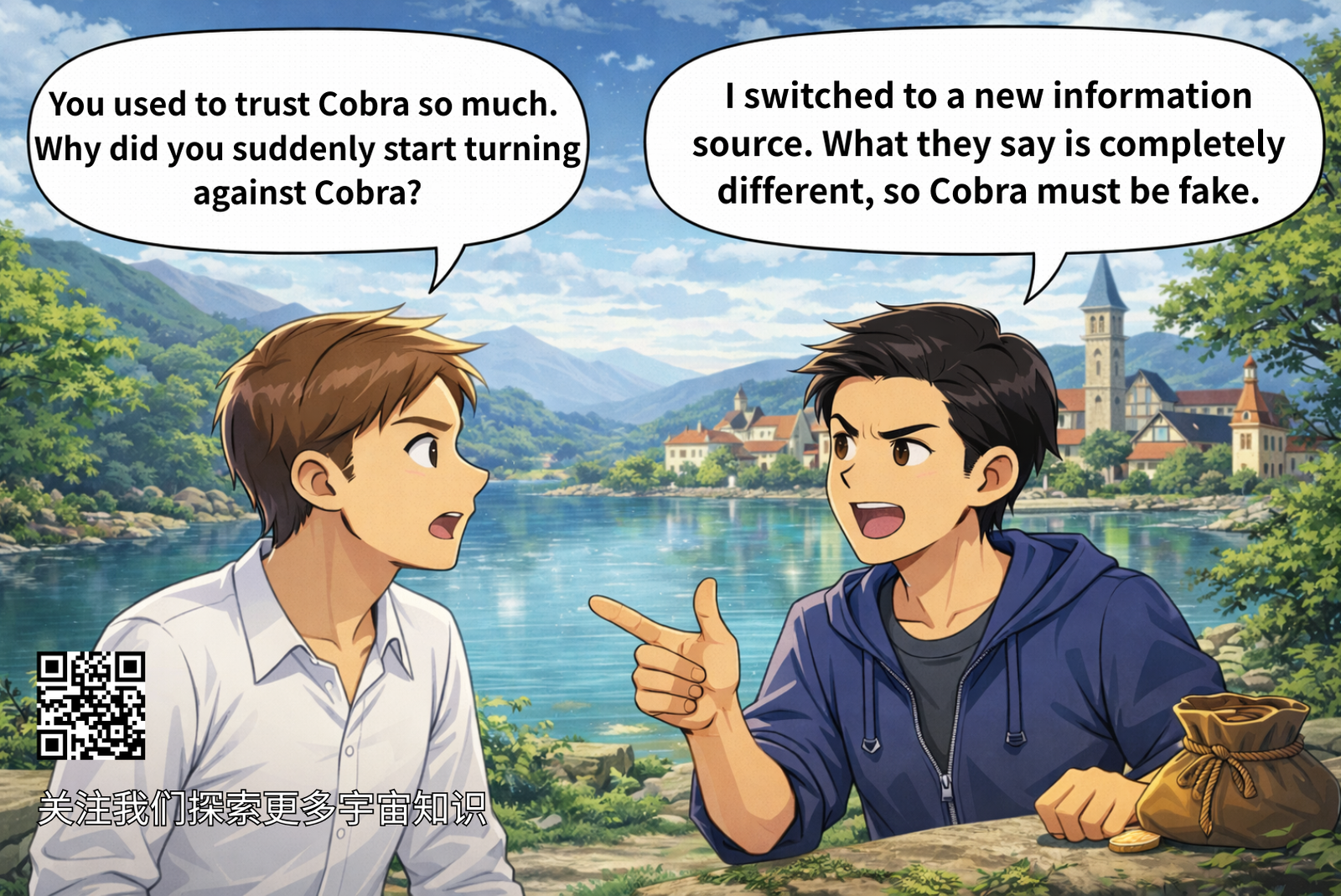

So if someone uses those differences to completely negate the other side, I see it as logically bankrupt. It is not truth seeking. It is binary thinking. What I believe now is true, so what I believed before must be false. The biggest benefit of this mindset is simple. I do not have to admit uncertainty. I just have to replace one authority with another and let the new idol carry responsibility for me.
That is why I see this, quite often, as a blind transfer of idol worship. It is not that they became clear eyed. It is that the object of faith moved from Cobra to someone else. The psychological structure stays the same, only the altar gets redecorated.
9.Invisible Doesn’t Mean Nonexistent: Why the “Tachyonization” Markup Becomes an Easy Target
On the subject of products, I want to add one detail that is frequently used as a line of attack, yet is also especially prone to conceptual bait and switch.
One reason some of Cobra’s products are priced above typical market value is that he claims to use a proprietary technique to apply a Tachyonization process to the item. To be frank, this kind of processing is not something mainstream audiences readily accept, and it is not the sort of difference you can easily confirm with the naked eye. Precisely because of that, it becomes the part critics cling to most: if they cannot see it, they treat it as “it must be a scam.”
But I do not think that style of opposition is objective or even reasonable. The logic is simple: “not visible” can at most lead to “hard to verify.” It cannot directly lead to “therefore it is fraud.” What is missing in between is evidence and reasoning, and what fills that missing space is often emotion and stance.
I often use an intuitive analogy to frame this. The same comb becomes more expensive after it is gold plated, and that is extremely common in the real world. The comb’s function may not double, but its cost, process, scarcity, and even “why people are willing to pay for it” genuinely change. More broadly, our lives are full of markups: brand markup, design markup, craftsmanship markup, limited edition markup, story markup, signature markup. A lot of value is not something you can judge at a glance. It comes from manufacturing, technique, reputation, and market consensus.
This is exactly why the claim of Tachyonization processing so easily sparks controversy: its premium is not anchored in a visible layer like gold plating, but in something more abstract. Critics grab onto that invisibility and turn it into a convenient shortcut conclusion: if I cannot see it, then you must be lying. But that is a classic form of conceptual substitution, swapping “hard to verify” into “already convicted.”
I am not saying every invisible premium is automatically reasonable. The market certainly contains exaggeration, vague claims, and cases where belief psychology is exploited for quick profit. A mature discussion should split the issue into two clearer layers.
The first layer is choice. As long as a transaction involves no coercion, no extortion, and no fear or threats used to force people to pay, individuals have the right to choose whether to buy or not. Some people are willing to pay for a certain kind of processing or a certain idea, while others feel it is not worth it. That is a normal feature of markets and does not, by itself, justify moral condemnation.
The second layer is integrity and inspectability. If someone charges a higher price for a form of processing that is not directly visible, a more reasonable expectation is that the description should be clear, promises should be restrained, personal claims should not be packaged as established science, and possibilities should not be sold as certainty. In other words, it can be questioned, but it should not be smuggled into a conviction.
So what I truly oppose is not questioning itself, but a lazy form of attack: refusing to distinguish the distance between “I don’t agree” and “you are scamming,” refusing to discuss whether the transaction is voluntary, whether the description is exaggerated, or whether the promises cross a line, and instead treating “I can’t see it” as the only evidence, then upgrading “I won’t buy it” into “you’re a fraud.”
I would rather bring this back to the central theme of my article. Many extreme opponents are not doing analysis. They are looking for an outlet for their anxiety. Once they have decided to negate someone, any part that is “hard to verify” becomes the most convenient hammer in their hands. And the moment that hammer comes down, discussion stops being discussion. It becomes a sentence.
That is why my intention here is straightforward: without stronger evidence, “invisible” should not be treated as “guilty.” Rationality is not about taking sides. Rationality is about finishing the reasoning, not letting emotion replace evidence, and not letting stance quietly swap concepts.
10. The Cherry-Picking Opponent: Treating a Fragment as the Whole, and Emotion as the Conclusion
Hearing one line and calling it a verdict: how cherry-picking pushes people into the anti camp
I also keep seeing another type of opponent, and it is both common and highly destructive to any real discussion. They hear only fragments of Cobra’s information, cherry-pick them, misread them through their own assumptions and prior beliefs, and then enter the battlefield with a conclusion they believe they already understand.
The biggest problem with this type of opposition is that their position is not built on a full understanding of Cobra’s messages. It is built on fragments. One sentence, one screenshot, one clipped retelling is enough to form a conclusion. Then the conclusion starts commanding their interpretation. The more they listen, the more it seems to match what they already decided. The more they look, the more it resembles what they imagined.
So the discussion shifts from “What is Cobra actually saying” into “What I think Cobra is saying,” and between those two lies an entire ocean.
I often see the cherry-picking process unfold like this.
First, they seize the sharpest, most inflammatory fragment, the one most likely to trigger controversy.
Second, they ignore the surrounding context and force that fragment into their existing framework.
Third, they swap “I feel” into “he is,” turning speculation into a verdict.
Fourth, they take that verdict into an echo chamber and receive applause, and that applause reinforces the verdict.
In the end, when someone points out Cobra’s intended meaning or the full context, the opponent does not go back to check the original message. They simply label the other person a defender, because the moment they verify the context, they would have to admit they never truly understood it in the first place.
This is why I keep emphasizing conceptual substitution earlier in the article. Cherry-picking is the perfect breeding ground for it. It replaces Cobra’s fragment with the full picture. It replaces other people’s retellings with Cobra’s original meaning. It replaces personal emotion with the other person’s stance. And finally it replaces “I do not like it” with “you are guilty.”
This kind of opposition looks fierce, but it is fragile. It is not supported by understanding. It is driven by emotion. More than anything, it resembles a pursuit of psychological victory rather than truth. If I can brand Cobra as the villain, then I do not have to face the harder question. How much did I actually understand from Cobra’s messages. What did I truly confirm.
I’m not writing this to demand that everyone must agree with Cobra. I’m simply hoping we can return to a more basic baseline for discussion: different views are fine, but don’t build a sense of moral superiority out of clipped fragments of information. Otherwise, it isn’t rational debate, it’s an initiation rite for a witch hunt.
11.The “Burying Is Just Selling” Claim and the Doubts About Effect: Separate the Commercial Inference from the Question of Effectiveness
“You bury things to help Cobra sell stones.” Why this accusation does not stand up
There is another line of opposition that I have to disentangle clearly. They claim that when Cobra encourages people to bury minerals and meteorites, it is simply to sell his own stones and to make people buy from him. At the same time, they question whether burying minerals and meteorites in the soil produces any benefit at all.
I think at minimum we have to separate two issues, or else the whole discussion gets dragged around by conceptual substitution again.
The first issue is the motive accusation: promoting burying equals selling stones.
The second issue is the effect question: does burying actually do anything.
These two are often blended together, but they operate on different levels.
Start with the motive accusation. To jump from “advocating burying” to “therefore it must be for sales” is a rash leap in causality. Even if a market exists and products are available, that does not mean an action-oriented advocacy is automatically a sales operation. And as I already explained earlier, Cobra’s content is not consistently accompanied by purchase links or direct demands that people buy. Yet critics replace “possible commercial relevance” with “the only purpose is to scam money.” The reasoning chain is incomplete and not persuasive.
Then the question of effect. I am not going to write this as a single sentence that demands the whole world accept it as a settled scientific conclusion. A more mature approach is to acknowledge that different frameworks exist.
Under an “energy” framework, minerals and meteorites are believed to carry certain characteristics and symbolic meaning. Burying them is seen as a way of anchoring those characteristics to a location. Conceptually, this is indeed similar to how ancient people used feng shui, geography, and spatial arrangement to adjust local “qi” or “magnetic field.” Whether you call it energy, field, atmosphere, psychological symbolism, or collective intention, the common thread is that humans have long used objects and layouts to influence how a place feels, how people behave, and what structures of belief take shape.
But even from a more pragmatic angle, dismissing all “burying” as pure nonsense is also too crude. Because “benefit” is not a single category. It often comes in more than one form.
What critics commonly do is reduce every possible form of benefit into only one: it must produce an immediate visible miracle. If they cannot see a rapid change, they declare it all a scam. That is the same old pattern again. Replacing complexity with simplification, and replacing uncertainty with conviction.
What matters most to me is basic fairness in discussion.
If someone wants to question the effects of burying, I understand that completely. But the questioning should target the claim itself, its scope, and how it could be examined. It should not jump straight to “therefore you are all being scammed.”
If someone wants to question possible commercial factors, I understand that too. But then they should provide a concrete causal argument, not treat a single line like “it must be for selling stones” as enough to execute every action.
Because once discussion collapses into this kind of blunt accusation, what gets destroyed is not only one person’s reputation. It is the entire spiritual community’s ability to do rational discussion at all. People start treating guesses as evidence, using motive trials instead of content analysis, and relying on moral superiority instead of reasoning. That is the truly frightening part.
Conclusion: Different Voices Are Not the Problem. Concept-Switching Is. The Extreme Psychological Path from Believer to Anti-Fan
After breaking the whole thing down, I am even more certain that what I want to say is simple. Different voices are not the problem. Questioning is not the problem. What truly throws the spiritual community into chaos, and pushes people step by step toward extremity, is a kind of opposition that wears the mask of reason while operating through conceptual substitution and emotional verdicts.
The most obvious feature of this new anti-Cobra wave is that the volume grows louder, the emotion grows heavier, and the argument grows thinner. Much of the opposition looks like it is discussing content, but it is actually switching concepts. It looks like it is analyzing information, but it is packaging emotion as conclusion, and finally turning into a form of self-protection where anxiety needs someone to carry the blame. It feels “abnormal” precisely because it often convicts first and then uses emotion as evidence. It is not seeking truth. It is seeking an exit.
When I trace the roots of this extremity, I keep arriving at two cores: belief collapse and scarcity consciousness. When someone stakes hope, meaning, and even life direction on the narrative of the Event, and the outcome they want does not manifest, the pain is not only disappointment. It is the collapse of their personal narrative.
Admitting that they misread, projected, and became dependent is too painful. So the easier version becomes: it is the other person’s fault, the other person is lying, the other person made me wait.
Scarcity consciousness then turns the Event into a lifeline. When the lifeline does not pull them out on schedule, they begin to imagine it as a noose. Hope becomes a wager. Waiting becomes resentment.
So in the end, the question I want to leave with you is this. I do not oppose questioning. What I oppose is using “questioning” as an outer shell that contains emotional certainty, conceptual substitution, and conclusions that convict before the reasoning is even completed. When you also get pulled by the wave, and you start wanting to join the condemnation, are you willing to pause for one second. Are you seeing Cobra’s original words clearly, instead of relying on retellings. Are you reasoning, or are you looking for someone to blame for disappointment. Are you facing reality, or using waiting to escape it. Are you truly becoming clearer, or simply replacing one object of devotion with another.
These questions are not romantic, but they are useful. Because when the winds of opinion are wild and the situation is muddy, they at least help us take our judgment back into our own hands. Not turning hope into a bet, not turning waiting into hatred, and not turning what we once believed into a reason to flip the table.
光圈反C热潮再起,从信徒到黑粉:偶像崇拜背后的极端心理:
https://ue-library.com/from-devotee-to-detractor-psychology-of-anti-c-backlash/
每一次转发,都是宇宙知识与灵性能量的扩散,让更多灵魂得以接触真相与揭露的火焰。
 微信打赏支持
您的打赏,不仅是鼓励,更是注入能量的行动,使宇宙地球图书馆能持续承载使命,将真相丶智慧与灵性传承下去。